


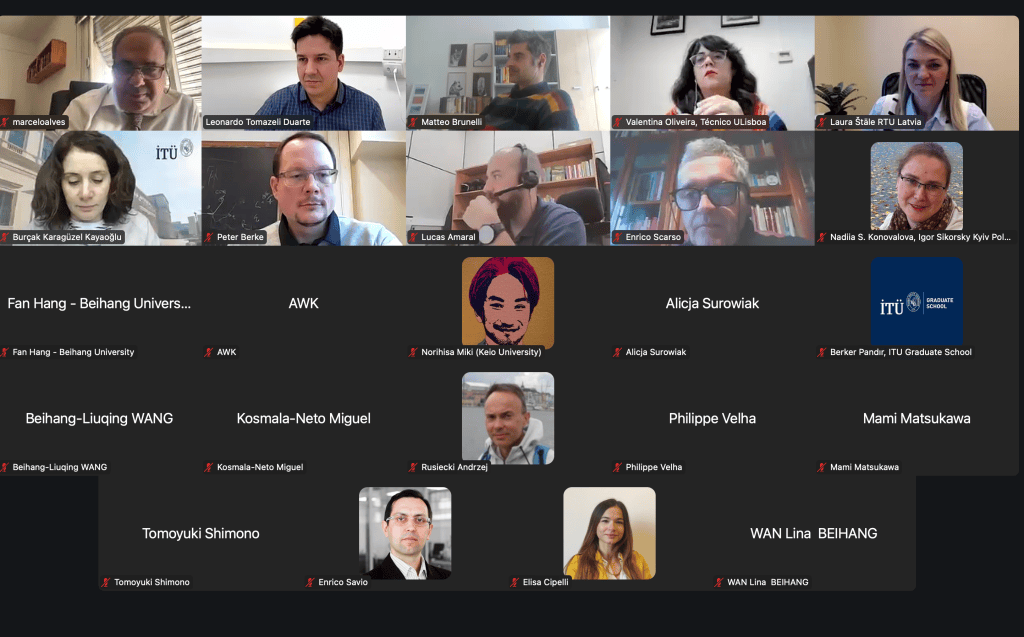
On February 11, 2025, the “T.I.M.E. in…Brazil” meeting brought together T.I.M.E. Members to explore collaboration opportunities with the University of São Paulo (Poli-USP) and the University of Campinas (UNICAMP). The discussion covered the specifics of the Brazilian higher education system, double-degree prospects, and research exchanges. Presentations by Prof. Marcelo Alves (USP) and Prof. Leonardo Tomazeli Duarte (UNICAMP) provided valuable insights into both opportunities and challenges in establishing partnerships with these institutions.

I – University of São Paulo (Poli-USP) and overview of the Brazilian Higher Education landscape
Prof. Marcelo Alves opened the session by providing an overview of higher education in Brazil. He emphasized that public education is tuition-free and state-funded, even for international students, including those pursuing double degrees. This unique characteristic presents a major advantage for foreign students looking to study in Brazil without incurring high costs.
USP, founded in 1934, plays a pivotal role in Brazilian academia. Recognized internationally, it consistently ranks as the top university in Latin America. The Escola Politécnica (Poli-USP) has a long-standing reputation for excellence in engineering and maintains strong ties with both industry and research institutions.
Several challenges were raised during the meeting:
- Language barrier: Most courses are taught in Portuguese, which can be an obstacle for international students. However, USP and UNICAMP offer language support, including free Portuguese courses.
- Academic system differences: Brazil does not follow the Bologna system. Engineering degrees last five years ;
USP and UNICAMP expressed flexibility in adjusting curricula to meet partner institutions’ needs.
II- UNICAMP: A Research-Oriented and innovative institution
Prof. Leonardo Tomazeli Duarte highlighted UNICAMP’s strong research orientation. The university contributes 7% of Brazil’s total scientific output and is actively engaged in fields such as energy, environment, health, and artificial intelligence. Many research centers receive funding from public agencies and private corporations, enhancing opportunities for international collaboration.
Beyond its engineering programs, UNICAMP fosters close cooperation with industries and startup development, providing students with a dynamic environment for professional growth. The university also offers research opportunities for international students through funded projects.
Strengthening collaborations
The discussion also addressed funding opportunities and faculty exchanges:
- Scholarships: While specific double-degree scholarships remain limited, research projects provide alternative funding sources.
- Faculty exchanges: Both USP and UNICAMP welcome international faculty for academic mobility and visiting professor programs.
- Seed funding for research: UNICAMP offers exploratory research project funding, which could facilitate new partnerships within the T.I.M.E. network.
Takeaways and next steps:
- Brazil offers high-quality, tuition-free education for international students.
- Double-degree students can benefit from full academic integration but must adapt to Portuguese instruction and a different degree structure.
- Research collaboration is a strong avenue, with funding available for joint projects and faculty exchanges.
- Institutions are flexible and willing to adjust curricula to enhance compatibility with European programs.
Conclusion
The meeting effectively showcased Brazil as an attractive academic and research destination. While language and curriculum structure may pose initial challenges, Brazilian institutions demonstrate openness and adaptability. Research, innovation, and industry connections provide additional incentives for collaboration.
Interested members are encouraged to reach out to Prof. Marcelo Alves and Prof. Leonardo Tomazeli Duarte for further discussions.
Contact:
- Prof. Marcelo Alves (USP – Escola Politécnica (Poli)) – University Profile | Research profile, malalves@usp.br
- Prof. Leonardo Tomazeli Duarte (UNICAMP, Faculty of Applied Sciences) – University Profile | research profile, leonardo.duarte@fca.unicamp.br